4-Week At-Home Workout Plan: Minimal Equipment, Daily
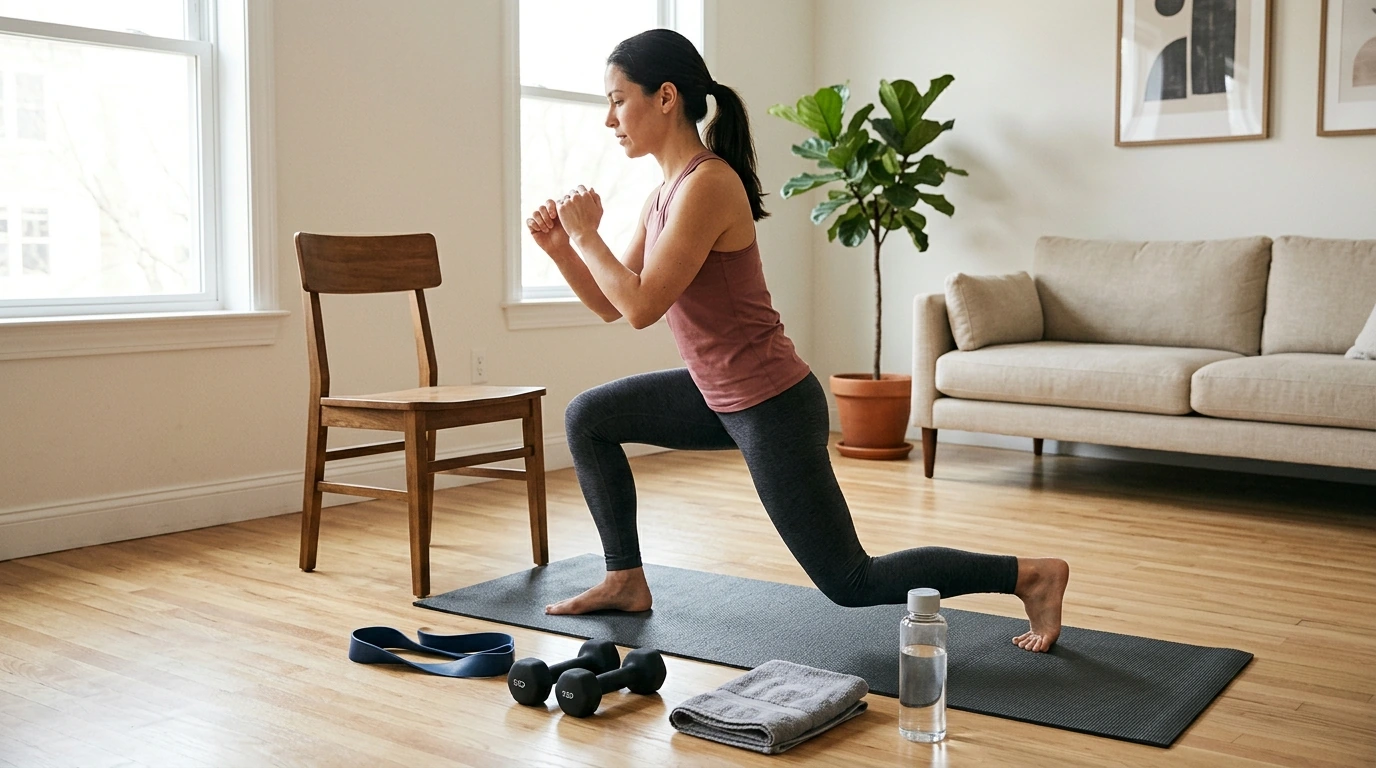
Fit at Home: A 4-Week Minimal-Equipment Workout Plan With Daily Workouts and Stretches
A simple, repeatable routine can make home fitness feel less overwhelming—especially when time, space, and equipment are limited. This guide lays out a four-week structure with daily workouts and stretches, plus clear options to scale intensity up or down so the plan stays realistic from week 1 through week 4.
For general health, most adults benefit from a mix of strength work and moderate-to-vigorous activity across the week; you can read the basics from the CDC and the American College of Sports Medicine (ACSM). The plan below keeps that spirit, but packages it into “what to do today” steps you can follow at home.
Who this 4-week plan works best for
- Beginners who want a structured schedule without a gym
- Busy schedules that need 20–40 minute sessions and clear “what to do today” direction
- Anyone rebuilding consistency after time off (travel, injury recovery clearance, life changes)
- Home exercisers with minimal equipment (mat, chair/bench, resistance band or light dumbbells optional)
- People who prefer daily movement that includes dedicated stretching and mobility
If you have a medical condition or you’re returning after an injury, follow any clinician guidance first and use the lowest-impact options until movement feels smooth and pain-free.
Minimal equipment setup (and smart substitutions)
You can do most sessions with household basics and a little cleared floor space.
- Core items: exercise mat, stable chair, water bottle, towel, timer
- Optional add-ons: resistance band loop, long band, light dumbbells (or filled backpack), yoga block
- Substitutions: backpack rows instead of dumbbell rows; towel hamstring stretch instead of strap; step-ups on stairs instead of a box
- Safety basics: clear floor space, shoes for jumping moves, non-slip mat for planks, keep a wall nearby for balance work
| If you don’t have… | Use this instead | Best for |
|---|---|---|
| Dumbbells | Backpack loaded with books | Squats, rows, deadlift pattern |
| Resistance band | Isometric holds (wall sit, plank) | Strength and control |
| Bench/step | Stair step or sturdy chair | Step-ups, triceps dips (with caution) |
| Yoga strap | Towel | Hamstring and shoulder mobility |
How the 4 weeks are structured (progress without overcomplicating)
The weekly rhythm stays the same, and the challenge rises gradually—so you don’t have to learn a brand-new plan every Monday.
- Weekly rhythm: 3 strength days, 2 low-impact cardio/conditioning days, 2 recovery-focused mobility/stretch days
- Progression: week 1 builds technique; week 2 increases total reps; week 3 adds tempo or an extra round; week 4 tightens rest and improves control
- Intensity control: choose a rep range that leaves 1–3 reps “in reserve” on strength sets; reduce impact by stepping instead of jumping
- Time options: “short” (20–25 min) by doing fewer rounds; “standard” (30–40 min) by completing full rounds and a mobility finisher
Practical progress marker: if you finish a session feeling like you could do a little more and your form stayed clean, you’re on the right track for repeatable week-to-week consistency.
Sample 7-day schedule (repeat weekly with small progressions)
Repeat this 7-day layout for four weeks. Each week, keep the same day themes and use one progression lever: add 1–2 reps per set, add one round, slow the lowering phase (tempo), or shave 10–15 seconds off rest.
| Day | Focus | Main work (example) | Stretch focus |
|---|---|---|---|
| 1 | Strength A | Squat, push-up (or incline), hip hinge, plank | Hips + chest |
| 2 | Conditioning A | 20 min intervals (low impact) | Calves + hamstrings |
| 3 | Strength B | Split squat, glute bridge, calf raises, side plank | Hip flexors + glutes |
| 4 | Recovery | Mobility flow 20–30 min | Full body (long holds) |
| 5 | Strength C | Row variation, overhead press (light), core circuit | Shoulders + upper back |
| 6 | Conditioning B | Circuit (work/rest) 20–30 min | Quads + lower back |
| 7 | Reset | Mobility + easy walk | Spine + ankles |
Week-by-week progression you can actually stick to
- Week 1 (learn it): 2 rounds on strength circuits; move slowly; prioritize range of motion you can control.
- Week 2 (add volume): add 1–2 reps per move or a third round on one strength day.
- Week 3 (add challenge): keep reps, add tempo (3 seconds down on squats/push-ups/hinges) or add a short finisher (30–60 seconds).
- Week 4 (build capacity): keep technique tight and shorten rest slightly; stay shy of failure so recovery days still feel restorative.
Daily warm-up and post-workout stretching (simple, repeatable)
5-minute warm-up template
Strength-day finisher (3–5 minutes)
Stretching staples (hold 20–45 seconds each)
On recovery days, shift to longer holds (45–90 seconds) and slower nasal breathing to downshift. For more home-friendly movement ideas, the NHS fitness guides are a helpful reference.
Common mistakes that slow progress (and quick fixes)
Printable plan option: daily workouts and stretches in one place
- Fit at Home: 4-Week Workout Plan | Minimal Equipment Exercise Guide PDF | Home Fitness eBook with Daily Workouts & Stretches (downloadable format for check-off-friendly daily structure)
- Conflict-Resolution Workbook for Couples | Printable Relationship Communication eBook | Improve Listening, Resolve Arguments, Rebuild Trust (supportive routines and communication tools that pair well with lifestyle changes)
- Homework Help Made Easy Toolkit for Parents – Printable Guide for Creating Study Habits, Homework Strategies & Independent Learning (time-structure ideas that can free up consistent workout windows)
FAQ
What is a good 7 day workout plan at home?
A balanced week includes 3 strength days (full body, lower, upper), 2 low-impact conditioning days, and 2 mobility/recovery days. Keep sessions around 20–40 minutes, warm up first, stretch briefly after, and progress weekly by adding a few reps, an extra round, or slightly reducing rest without training to failure every day.












Leave a comment